

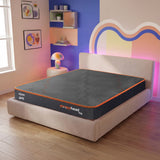

Some people are kept awake by insomnia while the rest of the world sleeps. A regular person spends 25% of their daily existence in bed on average. Whether you spend this time happily snoozing or tossing and turning is determined mainly by your online mattress.
Given how much time you spend in bed, it's only natural that getting adequate sleep and having a comfy mattress are linked and that having both will help you avoid back pain and improve your health. Learning about better sleep habits and mattress suggestions can help make your nights (and mornings) much more enjoyable.
What Effect Does A Mattress Have On Your Sleep?
The network of tiny blood vessels known as capillaries that run underneath your skin can be affected by the mattress that you sleep on. A mattress that relieves pressure points on your body will help you sleep soundly at night. However, if you lie down on your back for too long on a bad mattress, your body will lose oxygenated blood. This sends a signal to the brain via nerve fibres and pain synapses in your skin. Turning over enhances blood flow to the area, but it disrupts your sleep for a short time. A mattress that relieves pressure points on your body will give you better sleep at night. However, each individual's ideal mattress is unique.
Connection Between Sleep And Overall Well-Being
Sleep disorders are harmful, expensive, and affect your overall life experience. Research highlights a lack of sleep as a major health concern, which just goes to show that getting a good night's sleep can be just as advantageous to our contentment and well-being as winning the jackpot.
 The Centre for Disease Control and Prevention (CDC) has identified inadequate sleep as a public health crisis. In the United States, about 50-70 million people suffer from sleep disorders, and one study found that over 1/3 of adults cannot get enough sleep. Sleep deprivation causes car crashes and workplace mistakes, leading to industrial or ecological disasters.
 In addition, sleep deprivation has several negative health consequences. According to the CDC, not getting enough sleep can lead to various chronic conditions such as obesity, diabetes, and cancer, as well as an increased risk of dying early. Finally, not getting enough sleep makes us angry and upset. Sleep deprivation reduces quality of life and can even result in depression.
Scientists at the University of Warwick in the United Kingdom have published new research highlighting the importance of sleep for public health and suggest that maintaining good quality sleep can elevate our mood significantly.
Things To Remember While Choosing The Best Mattress For Better Sleep
Finding the best mattress isn't about looking for the most technologically advanced product or having to spend huge sums of money. Bear in mind the following aspects when shopping for the right mattress:
In addition, sleep deprivation has several negative health consequences. According to the CDC, not getting enough sleep can lead to various chronic conditions such as obesity, diabetes, and cancer, as well as an increased risk of dying early. Finally, not getting enough sleep makes us angry and upset. Sleep deprivation reduces quality of life and can even result in depression.
Scientists at the University of Warwick in the United Kingdom have published new research highlighting the importance of sleep for public health and suggest that maintaining good quality sleep can elevate our mood significantly.
Things To Remember While Choosing The Best Mattress For Better Sleep
Finding the best mattress isn't about looking for the most technologically advanced product or having to spend huge sums of money. Bear in mind the following aspects when shopping for the right mattress:


 Conclusion
If you're having trouble sleeping, the problem may not lie with the mattress itself but with its age. People must understand that mattresses have a limited lifespan. When you leave your mattress unattended for an extended period, the foam and other materials inside will begin to degrade, jeopardizing its ability to support your body.
Hence, avoid using a mattress for more than ten years. When it’s time to go mattress shopping again, remember the points mentioned above to make a smart choice!
Conclusion
If you're having trouble sleeping, the problem may not lie with the mattress itself but with its age. People must understand that mattresses have a limited lifespan. When you leave your mattress unattended for an extended period, the foam and other materials inside will begin to degrade, jeopardizing its ability to support your body.
Hence, avoid using a mattress for more than ten years. When it’s time to go mattress shopping again, remember the points mentioned above to make a smart choice!
The Centre for Disease Control and Prevention (CDC) has identified inadequate sleep as a public health crisis. In the United States, about 50-70 million people suffer from sleep disorders, and one study found that over 1/3 of adults cannot get enough sleep. Sleep deprivation causes car crashes and workplace mistakes, leading to industrial or ecological disasters.
In addition, sleep deprivation has several negative health consequences. According to the CDC, not getting enough sleep can lead to various chronic conditions such as obesity, diabetes, and cancer, as well as an increased risk of dying early. Finally, not getting enough sleep makes us angry and upset. Sleep deprivation reduces quality of life and can even result in depression.
Scientists at the University of Warwick in the United Kingdom have published new research highlighting the importance of sleep for public health and suggest that maintaining good quality sleep can elevate our mood significantly.
Things To Remember While Choosing The Best Mattress For Better Sleep
Finding the best mattress isn't about looking for the most technologically advanced product or having to spend huge sums of money. Bear in mind the following aspects when shopping for the right mattress:
- An expensive mattress does not always imply better quality. The fabrics that are in the mattress as well as the advertising contribute to the high market value. Consider what you need from a mattress rather than the price or the brand name. Choosing a mattress is a personal matter. Some people prefer firmer mattresses, while others prefer softer ones. Although there isn't much scientific evidence to suggest that one is better than the other, pick a soft or firm mattress depending on your health conditions.
- Anyone suffering from back or neck pain should view mattress shopping in the same way Goldilocks did: not too tough, not too delicate. You will sink to the bottom if your mattress is too soft. However, a hard mattress strains the lower spine, shoulders, and back of the head. A medium-firm mattress, or one with a softer pillow top, will provide just the right balance of support and padding for your spine.
- If you ever need to take naps with your head elevated, an adjustable bed from Sleepyhead may be a good investment. Elevating the head is sometimes recommended by experts for people with COPD to breathe simpler or to avoid GERD-related nighttime acid reflux. These mattresses can also help relieve pressure on sore joints by allowing you to place your hips and knees at a 90-degree angle.
- If you suffer from allergies or asthma, you may have thought about buying a ‘hypoallergenic’ bed. Instead, invest in a clean mattress casing rather than an allergen-free mattress. This will create a gap to keep dust mites away from the mattress. A mattress casing reduces growth of allergens by depriving dust mites of their food source.
- Although there is some evidence that pricey foam mattresses can aid with spine issues and improve sleep, the difference between them and a usual coil mattress is minimal. If your bed partner’s movements keep you awake at night, a memory foam mattress can really help you sleep better. Foam mattresses decrease motion transfer, allowing you to remain still as your partner tosses and turns.
- You would not buy a vehicle without taking it for a test drive. So why would you spend thousands on a mattress before even trying it out? Take a test nap on any new mattress before buying. Buyers shouldn't be ashamed to take a 10-minute nap on a mattress at the store.
Conclusion
If you're having trouble sleeping, the problem may not lie with the mattress itself but with its age. People must understand that mattresses have a limited lifespan. When you leave your mattress unattended for an extended period, the foam and other materials inside will begin to degrade, jeopardizing its ability to support your body.
Hence, avoid using a mattress for more than ten years. When it’s time to go mattress shopping again, remember the points mentioned above to make a smart choice!