

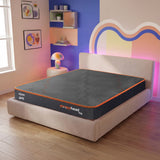

Here's something that'll make you sit up straight: the average person spends roughly 26 years asleep over a lifetime, and yet, most of us spend more time researching a smartphone than the surface we sleep on every single night. A bad mattress doesn't just ruin your morning; it quietly chips away at your posture, your mood, and your long-term health.
So the next time you're mattress shopping, don't just press down on it and nod thoughtfully. Here's how you could exactly tell a great memory foam mattress from a usual foam block.
Did You Know?
Memory foam was originally invented by NASA in 1966, developed for airplane seats to absorb crash impact and relieve pressure on astronauts during liftoff. It took another two decades before it made its way into mattresses. Today, it's one of the most popular sleep materials in the world.
Step 1: Check the Foam Density (The Invisible Quality Test)
You can't judge a mattress by its cover. The real indicator of quality lives inside: foam density. High-density foam means the mattress will hold its shape for years. Low-density foam compresses quickly and leads to the dreaded "sinkhole" effect within months. Ask the brand directly, or look for it on the spec sheet. If the product page doesn't mention density at all, that's already a yellow flag.
Step 2: Understand the Layer Breakdown
Premium mattresses are built in layers, and each layer has a job. A quality mattress typically has a firm support base (high-density foam or springs), a transitional middle layer, and a comfort layer on top (often memory foam or latex). Single-layer mattresses may feel fine initially, but lack the engineering to distribute weight properly over time. A multi-layer construction signals that the brand has thought about sleep science, not just cost-cutting.
Interesting Insight:
Memory foam reacts to both body heat and pressure; it literally softens where you are warmer and firmer where you're not. This is why it cradles pressure points like hips and shoulders while keeping your spine aligned. The denser the memory foam, the longer it retains that adaptive property. Cheap memory foam loses this responsiveness within 1–2 years.
How to Judge Mattress Quality: A Step-by-Step Guide
1. Test for Spinal Alignment, Not Just Comfort
The "sink in and feel comfy" test most people do in stores is misleading. A good mattress should keep your spine in a neutral position, not let your hips sag, or your shoulders scrunch. Side sleepers typically need a medium-soft feel; back and stomach sleepers need more firmness. When testing, lie in your actual sleep position for at least 5-10 minutes.
2. Press the Edges
Sit on the edge of the mattress. A quality build uses reinforced edge support so the mattress doesn't collapse. Weak edges mean you lose usable sleeping surface and the mattress wears unevenly. This is especially important for couples or anyone who tends to sleep near the edge of the bed.
3. Check for Orthopedic Endorsements
Look for orthopedic certification or endorsement from sleep/health bodies. This isn't just a marketing badge; it means the orthopedic mattress has been evaluated for spinal support and pressure relief. Some brands also hold ISO certifications for manufacturing quality, which speaks to consistency across production.
4. Read the Warranty
A mattress warranty is the brand's confidence in its own product. A one-year warranty on a mattress you'll sleep on daily is underwhelming. Quality mattresses often come with 7–10 year warranties or more. Read what's covered: body impressions deeper than 2.5 cm, foam deterioration, and fabric failures are typical quality indicators. A long warranty is a brand telling you, "We stand behind this."
6. Insist on a Trial Period
Your body takes 2-4 weeks to fully adjust to a new sleep surface. Any brand confident in their product will offer a trial period; 30, 60, or even 100 nights. If a brand doesn't offer returns or trials, that's a significant red flag. This is one of the clearest signals of product quality and brand trust.
The Science of Memory Foam: Why It Changed Sleep Forever
Memory foam (technically called viscoelastic polyurethane foam) is one of the most researched sleep materials in history. It was designed to be "energy absorbent and soft”, properties that make it uniquely suited to distribute body weight and relieve pressure. Here's why the specs actually matter:
- Response time: Good memory foam bounces back in 4-5 seconds after pressure is released
- Density benchmark: High-quality memory foam layers measure 40+ kg/m³
- Lifespan: Quality memory foam mattresses last 7–10 years with proper care
- Pressure relief: Studies suggest up to 30% reduction in pressure points vs traditional spring beds
Low-quality memory foam skips on density and uses fillers, causing it to bottom out quickly and lose its adaptive properties. Always check density specs; it's the number that separates budget foam from genuine sleep engineering.
Sleepyhead Memory Foam Mattresses
Here are three of our standout memory foam mattress options:
1. Original - BodyIQ Orthopedic Memory Foam Mattress
A 3-layered memory foam mattress with orthopedic support and a high-density base. It features their proprietary BodyIQ orthopedic foam technology designed to distribute body weight evenly and relieve pressure points. Perfect for everyday use and suitable for all sleeping positions. It offers zero partner disturbance and ensures peaceful sleep by minimizing disturbance from partner movements. It is wrapped in breathable fabric that keeps your mattress fresh throughout the night. You get 100 nights free trial and 10 years warranty with Original.
2. Sense - BodyIQ Memory Foam with Cooling Technology

Built with active cooling technology layered on top of BodyIQ orthopedic memory foam, Sense is built for Indian sleepers. Designed with a 3-zoned orthopedic support foam base layer, Sense targets and supports your pressure points and contours your body shape. This strategic support not only alleviates discomfort but also promotes proper spinal alignment, allowing for optimal rest and recovery. With Sense, you get a 100-night free trial and a 10-year warranty.
3. Laxe - Pincore Latex + BodyIQ Orthopedic Memory Foam
Combines natural pincore latex with BodyIQ memory foam for full-body support, natural cooling, and a gentle bounce. Pincore latex has tiny pin-hole perforations that allow airflow and give the mattress a springier, more responsive feel than foam alone. A great choice for those wanting the best of both materials, the pressure relief of foam with the buoyancy of latex. It features 3-zone CNC cut foam; softer where you need it (shoulders), firmer where it matters (hips), and balanced all the way through. Wrapped in a premium 550 GSM self-quilted knit fabric, Laxe looks as good as it feels. You can try Laxe with 100 nights free trial, and it comes with 10 years warranty.
A good mattress isn't something you buy and forget. It's something you experience every single night, and it directly affects how you feel every single morning. The steps above aren't complicated; they just require you to slow down and ask the right questions before you swipe your card.